Why Sustainable Giving Requires Rethinking Nonprofit Finance
I took exactly one distance learning course in college.
Finance.
And I immediately regretted it.
To be fair, this was the early days of the internet and online learning. Not today’s polished video platforms and interactive lessons. Back then, “distance learning” basically meant a stack of assignments and a very thick textbook.
I took the course over the summer between my sophomore and junior years. Most afternoons consisted of sitting at the kitchen table, flipping through that textbook (yes, an actual printed book), and trying desperately to stay awake while reading what had to be one of the driest subjects imaginable.
It wasn’t just boring – it also wasn’t intuitive.
Finance felt like a foreign language I hadn’t studied for.
Somehow, I survived the course and made it through the summer – deeply grateful that I never had to take another distance learning class again.
Fast forward a few years.
After starting my first company (a longboard skateboard company – a story for another time), and later working in marketing and advertising, I began to realize something important:
Finance may not be exciting – but it is essential….
Budgeting.
Cash flow.
Income statements.
Finance is the infrastructure that every organization runs on, and when that infrastructure is designed well, everything else can grow.
But when it’s built around the wrong assumptions, it quietly limits what’s possible.
I’ve come to believe that’s exactly where many nonprofits are today.
When it comes to scaling sustainable recurring giving, most organizations are trying to grow a subscription-style revenue model using financial frameworks designed for one-time transactions.
And that creates real limitations.
Thankfully, we don’t have to figure this out from scratch.
Another sector has already gone through this transformation — the subscription economy.
Finance and Subscription Business Models
Subscription businesses operate under fundamentally different financial logic than traditional one-time-transaction businesses.
And when a business shifts from one-time transactions to recurring relationships, its financial model has to change as well.
Tien Tzuo was one of the first employees at Salesforce, helping pioneer the software as a service, and is now CEO and Founder of Zuora and author of the best-selling book SUBSCRIBED: Why the Subscription Model Will be Your Company’s Future – and What to Do About It.
Tzuo is credited with coining the phrase “Subscription Economy,” and his company Zuora has published the annual Subscription Economy Index, which I featured in The Rise of Sustainable Giving:
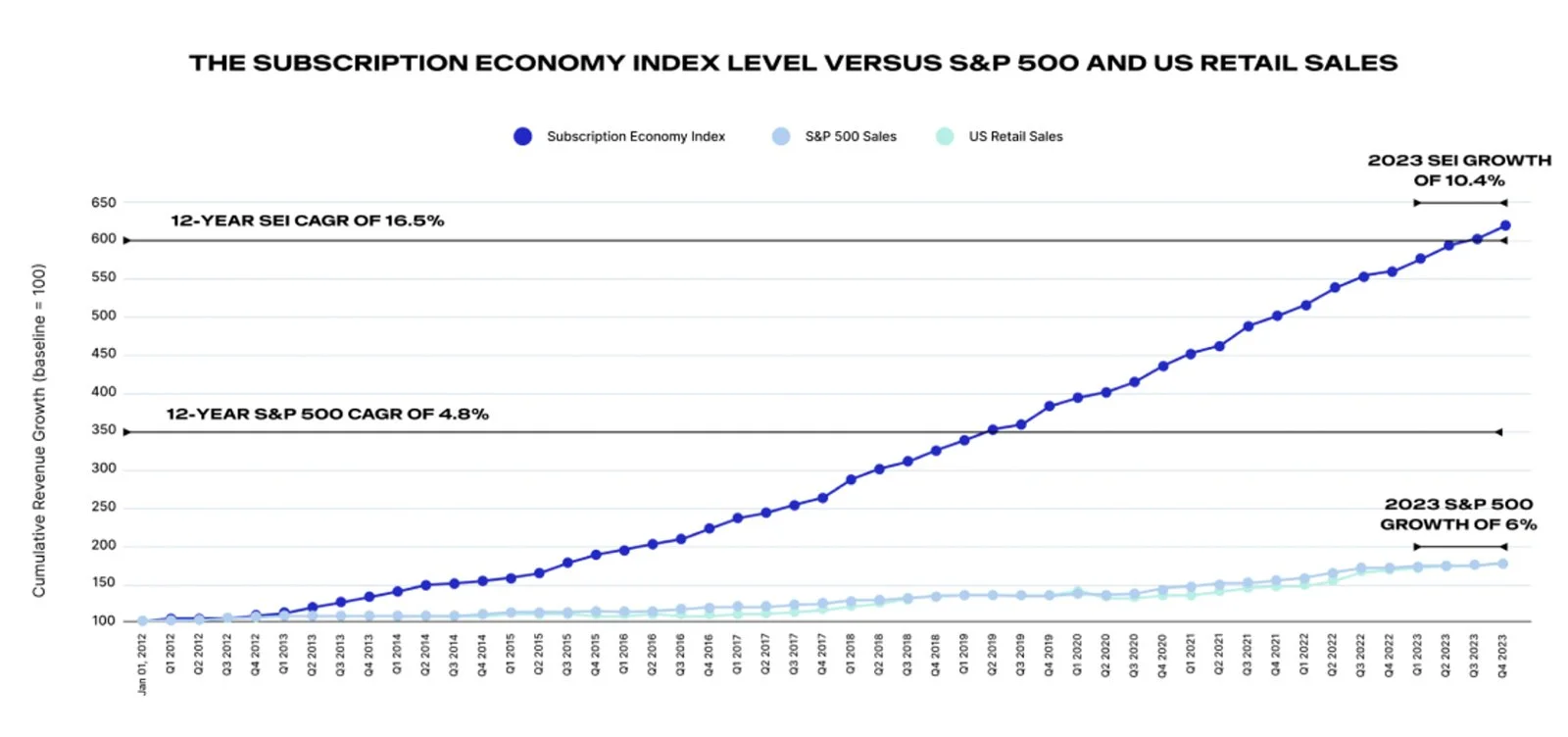
Above: The Subscription Economy Index, published by Zuora, shows that subscription-oriented businesses have outperformed the general market by 4X over the past 12 years.
In his book, Tzuo dedicates an entire chapter to the foundational role finance played in reinventing the subscription business model. In chapter 13, titled “Finance: The New Business Model Architects,” Tzuo recounts an embarrassing meeting with his board after presenting what he thought was an aggressive subscription growth plan.
His board responded with “So, let me get this straight. You want to spend more money, in order to grow less? What is wrong with you guys?”
Tzuo realized that he had been approaching growing a subscription business using a traditional finance mindset:
…I realized we weren’t explaining things the right way. We had delivered the plan using a traditional financial model, a pro forma income statement that was backward-looking and couldn’t show the return we would be making on our growth investments.
Tien Tzuo, SUBSCRIBED
He goes on to share that they came up with a whole new Subscription Economy income statement that reimagined how to measure a business primarily focused on creating a snowball effect of future value – one that Tzuo and his team would go on to teach to some of the biggest subscription businesses in the world.
I believe charities must go through a similar transformation in how they measure, plan, and think about finance if they are going to fully leverage sustainable recurring revenue to grow their impact.
To understand why, we have to look at where most nonprofit financial models start — and where they begin to break down.
The Limits of Transaction-Based Finance
The traditional financial models used by most organizations today have a few significant drawbacks.
Traditional finance is backward-looking
By definition, income statements look backwards. They ask the question – how much did we spend, and how much did we get back from that spend?
When it comes to sustainable giving, the problem is that the returns are not realized in the past – they are realized in the future.
Traditional finance is short-sighted
Budgeting is typically done at the quarter- and fiscal-year levels, far too short a time horizon to capture the true value of recurring giving.
Neon One found that the average tenure for a new recurring donor was 8.08 years. If we assume that length of time, if I spend $300 to acquire a recurring donor today but only count income for the months remaining in the fiscal year, I could be missing up to 99% of the value of the recurring donor by looking only within the first fiscal year.
Just like the subscription industry figured out, there are critical differences when measuring, budgeting, and planning for sustainable giving.
Finance has a leading role to play in architecting a new system to plan, budget, measure, and scale sustainable charities.
Finance in an Age of Sustainable Giving
As we enter an era of sustainable recurring giving, there are several key elements that need to come together for finance to lead in architecting a new model for sustainable growth.
It starts with looking forward.
Forecasting Forward, Not Just Reflecting Backward
For decades, finance teams have primarily been historians.
They tell the story of what already happened.
How much was spent.
How much was raised.
How the numbers compare to the budget.
Those things matter. But in a subscription-oriented model, they are no longer enough.
Recurring revenue creates a pipeline of future value that already exists today. A recurring donor who commits $40 per month has already created a stream of future revenue that will unfold over months and years.
The job of finance, then, is not simply to record what happened – it’s to model what is likely to happen next.
Forward-looking metrics like Monthly Recurring Revenue (MRR), Annual Recurring Revenue (ARR), donor retention, and projected long-term value (LTV) become the tools that allow leaders to see the future they are building.
In a sustainable giving model, finance becomes less like accounting… and more like navigation.
Planning in 3-Year Cycles
Most nonprofit financial planning happens one fiscal year at a time – but recurring revenue simply doesn’t behave that way.
When you acquire a recurring donor today, you are not acquiring revenue for just this fiscal year – you are acquiring a relationship that will ideally produce revenue for many years to come.
That means the investments required to grow recurring giving often look inefficient when measured against a single-year budget.
The solution is not to stop investing.
The solution is to extend the time horizon.
Subscription companies often plan growth in multi-year cycles because they understand that the investments made in year one create compounding value in years two and three.
Nonprofits pursuing sustainable giving must adopt a similar mindset. In fact, when I spoke with Sofia Machado Lemus of Operation Smile on the Sustainable Giving Podcast, she shared how shifting to a multi-year planning cycle was transformative for their team as they worked to grow sustainable giving.
When leaders begin to plan recurring donor growth across three-year windows instead of twelve-month budgets, the economics start to make much more sense.
Incorporating Long-Term Value
Another critical shift is learning to measure what a recurring donor is actually worth. Traditional fundraising metrics often evaluate performance based on cost per gift or return within the fiscal year.
But recurring giving fundamentally changes the math.
If a donor gives $40 per month and stays for several years, the value of that donor could easily exceed $1,600 over time.
Seen through that lens, investing $200, $300, or even more to acquire that donor suddenly looks very different.
Subscription businesses long ago adopted long-term value (LTV) as one of their most important metrics.
Nonprofits that want to scale sustainable giving must begin to do the same.
Because once you understand the long-term value of a recurring donor, you can make smarter investments in acquiring and serving them well.
The Snowball Effect of Sustainable Giving
When done right, recurring giving creates something powerful.
Momentum.
Each new recurring donor doesn’t just add revenue for today. They contribute to a growing base of committed support that continues generating income month after month.
That base becomes the foundation for future growth. New donors are added. Existing donors stay and upgrade. The monthly revenue grows steadily.
Over time, what started as a small stream becomes a powerful financial engine.
This is the snowball effect of sustainable giving — and it’s one of the most important reasons subscription businesses have outperformed traditional models for more than a decade.
💡 Takeaway: Finance is not just a reporting function. In the age of sustainable giving, finance can become a strategic architect of growth. The organizations that thrive in the years ahead will be the ones whose finance leaders help their teams:
• Forecast the future, not just record the past
• Plan in multi-year cycles, not just annual budgets
• Measure long-term donor value, not just short-term returns
• Invest in building a recurring revenue engine that compounds over time
Tzuo sums up the opportunity for a new era of subscription finance this way:
“Traditionally, 80 percent of a CFOs job was to tell people what happened... The other 20 percent was to interpret those numbers to direct resources, create forecasts, and manage strategy. Today that ratio has flipped.”
I believe the same opportunity exists in the nonprofit sector.
Finance leaders have a chance to become the architects of a more sustainable future – helping their organizations move beyond short-term thinking and toward models that generate reliable, compounding support for the mission.
Because the shift to sustainable giving isn’t just a fundraising transformation.
It’s a financial one too.
Until next week… Surf’s Up! 🌊
- Dave