To Innovate, You Have to Challenge Convention
I published a version of today's article three years ago in April.
This week, we hosted a Sustainable Giving Summit for a client. It's one of my favorite days. In that room, we were reminded of the importance of this lesson: If we want to keep getting the same results, we should keep doing what we're doing.
But if we want different results — if we're stuck, especially in areas where change is hard — we have to be willing to see differently.
I write today's Wave Report with a sense of gratitude.
I'm grateful for you. You keep showing up. You forward these articles to friends and colleagues. You trust me with a few minutes of your attention, and that is not something I hold lightly. The readership of the Wave Report has grown 15X since that original article. I've shown up week after week, and so have you. I'm thankful.
Which brings me to why I'm revisiting one of my earliest Wave Reports today.
I need the reminder. When times are hard, or results are down, or change is not happening and I'm frustrated, one of the first questions I have to ask is: am I following the conventional path? Am I doing the same thing we've always done and expecting different results?
Helping clients challenge assumptions is at the center of what we do. But I need this reminder as much as anyone. So here it is — with one update I think you'll find striking.
Why challenging conventional wisdom is key to leading innovation
I have a talk I give on the four “Myths” of innovation that hold leaders back. The second myth that I talk about is that “Innovation is new.”
When I say the word "innovation," what comes to mind?
For some leaders today, subjects that come to mind include things like A.I. Cryptocurrency. Electric cars.
Leaders tend to assume that innovation is the domain of new things. Things that have never been seen before, never been done before. The latest and greatest. The cutting edge.
It's innovation, after all, so if it's been done before, is it really innovative?
But is it innovation if it doesn't make a lasting impact?
Take the metaverse. When I first wrote this in April 2023, the metaverse was being heralded as the greatest innovation since the invention of the internet.
This week, as I'm writing this update – Meta announced hundreds of layoffs in its Reality Labs division and the shutdown of Horizon Worlds, its flagship metaverse platform.
“Meta lays off hundreds amid AI spending, fizzled metaverse plans” (Seattle Times)
I want to be clear: the goal here is not to mock new technology or dismiss bold ideas.
Some of today's experiments will become tomorrow's infrastructure. But that's exactly the point.
But history is the only lens with enough distance to tell us which "innovations" actually made a lasting difference. The metaverse has not found its footing. But right now, it illustrates the trap of confusing novelty or newness with impact.
Suppose your definition of innovation includes making a significant and lasting difference in the world. In that case, it stands to reason that we can learn much from innovations in the distant past that have shaped the world we live in today.
The truth is that innovation is not new. Innovation is ancient.
Let's look at three historical insights you can apply to your leadership today.
Innovation and challenging convention
When we study people like Filippo Brunelleschi, who built the famous Duomo Catheral in Florence, or Martin Luther helping to spark and lead the Protestant Reformation, we see that in the face of overcoming a difficult challenge, they do three things:
1. Challenge the commonly-held beliefs of their day.
There is a questioning of the status quo that has existed for decades or centuries. For Filippo Brunelleschi, the common belief was that masonry-based domes were built using wooden buttressing.
This was a problem for Brunelleschi, whose task was to build a dome that would ultimately reach a height of 376 feet, making the use of wooden buttresses nearly impossible. Entire forests would have had to be cleared, and even then, it would be difficult to build at such a height.
Brunelleschi instead devised several innovative methods, including laying bricks in an ingenious and unusual pattern that prevented them from collapsing on each other and constructing two domes — an inner dome and an outer dome — something that never had been done before. Finally, he devised enormous hoops made from stone and chains that aided in holding everything together.
To this day, the Duomo is the largest masonry dome ever built – a feat that hasn’t been repeated.
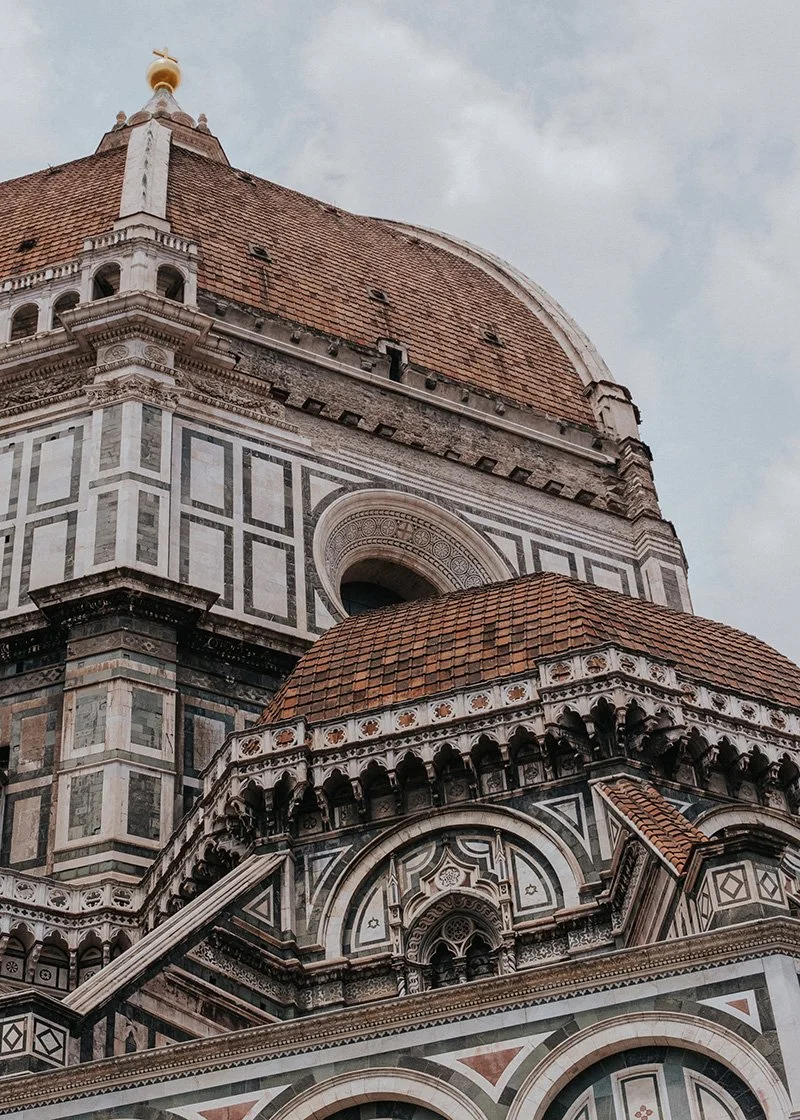
Above: To this day, the Duomo is the largest masonry dome ever built
As a secretive man, where Brunelleschi got his inspiration is not well documented. But we know he traveled and saw other cultures' and societies' approaches to architecture and engineering. This exposure, and his refusal to accept conventional wisdom in the face of a new and difficult challenge, led him to innovate.
💡 Takeaway: Innovation requires challenging the commonly-held beliefs around you – "that has never worked before" or "this is how we do that." Get out and get exposed to other organizations, cultures, and ways of doing things far outside your world.
2. Leverage new technology to achieve unprecedented scale and reach.
Coming back to Martin Luther, let's talk about the printing press. The Gutenberg press was invented more than 70 years before Martin Luther nailed his 95 Theses to the church door in Wittenberg. By many standards, the printing industry must have felt mature in 1517.
Think about that. The printing press would have been considered established, even old, technology in Luther's day.
But the reality was that most printing in the early 1500s was focused on low-volume, high-cost printing of academic and religious works. Few common people could afford books in the early part of the 16th century.
Luther saw an opportunity to produce many small printed works. These booklets – tracts, really – could be printed en masse and distributed to the people cheaply. This was a key innovation, along with the use of illustrations.
By the way, did you know that the foundations of the internet are only about 50 years old? We often think of the internet as established, even old technology. But the internet is young, by printing press standards. What might be possible in the next 10-20 years, thanks to the internet that we could have never imagined?
💡 Takeaway: How might you use technology to 10X or 100X what you are doing? A.I. presents some of the most interesting opportunities today, but there are other technologies — streaming video, social media, cloud computing — that your organization could utilize to 10X your impact.
3. Develop unconventional approaches.
Innovators seeking breakthrough results often have to challenge conventional ways of doing things entirely.
Martin Luther used three unconventional methods to get his message across.
First, he wrote in the language of his people — common German. Scholars of his day wrote almost exclusively in Latin, the language of academic debate. But Luther had a mission: he wanted his ideas accessible to ordinary people.
Second, he utilized illustrations. His colleague Lucas Cranach had perfected the art of woodcuts, which could be mass-produced. This allowed Luther to include vivid imagery that ignited the imagination of his readers.
Finally, Luther's writing style itself was unconventional. He did not use the dense, intellectual tone of his contemporaries. Instead, he used powerful, evocative, emotional language. Strong verbs. Short sentences. He was a master of accessible language on difficult topics — remarkable and unconventional for his day.
💡 Takeaway: What is the conventional approach to communicating your message in your sector? What might you question and do differently than your peers?
Three years ago, I sent this to a few hundred people who were kind enough to read it. Today, I'm sending it to thousands more who are kind enough to keep reading. I don't know exactly what the next three years hold, but I know that I’ll keep showing up, keep questioning convention, and keep doing the work.
Thank you for being on this journey.
Until next week… Surf’s Up! 🌊